
India’s appetite for building the “largest” — biggest statues, biggest stadiums, biggest infrastructure — is not accidental. It is part symbolism, part economic signalling, and part genuine capacity creation. But the real question, as you may rightly ask, is: how much of this has been built to what end and aim?
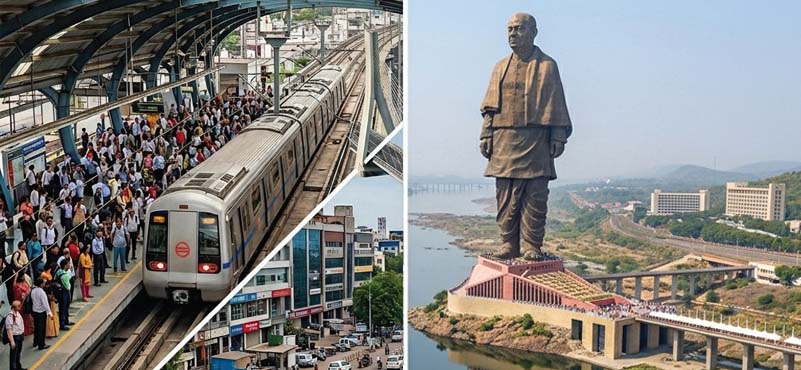
There is Monumental Symbolism, one that comes from Tourism and an identity, like that from a project recently executed, the Statue of Unity, said to the world’s tallest statue (182 m), with an honest and transparent intent at Nation-building as well as building a tourism magnet. The outcome as the story goes so far is drawing almost 5 million visitors annually and also triggered a full ecosystem comprising hotels, rail connectivity, riverfront, jungle safari, much of which is also ongoing and likely to carry on. One can easily give it a success ratio. Why it worked is also that it didn’t remain a standalone “vanity project,” though it did look like one, with an expenditure said to be in excess of Rs. 2500 crores. There were political statements in that, some idealism as well.
The fact is that it has fast evolved into a destination cluster, which is key. The planners went beyond just making a statue. It is symbolism, national pride and much more, it is also reflective of a growing tourism profile of the state in which it is situation – Gujarat.
Mega Sports Infrastructure often remain underutilised assets. Compare the various sites developed for Asian Games and then for the CWG, even though many of the earlier sites developed were used by the latter. But then we see the newer Narendra Modi Stadium with a claim to being the World’s largest cricket stadium with a capacity to hold 1,35,000 attendees – while the intent would have been to acquire Global sporting prestige with the ability to host marquee matches (World Cup finals, IPL) but it will remain subject to a relative low utilisation outside big events. Its success ratio will remain moderate, for some time to come. But then is being backed with bids for CWG, Olympics and more; the story will unfold and may just justify in the years ahead. Cities mostly build when chosen as venue but then you also need to establish your credentials to host them.
If you analyse the larger global business that comes broadly under MICE, meetings and conventions, the global average size is under 1000 delegates, for some 65% of the events. The bigger ones are only on the fringes. It’s the medium sized venues that give more utility and return on investment. Most often, the scale alone doesn’t ensure usage. Demand for such large venues is episodic, not continuous.
Airports and Aviation, as an industry, are another big area of large-scale projects. We have witnessed two of them recently, the Navi Mumbai airport and the Noida International Airport. Both are laying claim to various firsts, biggest this and biggest that.
These answer claims to India being among largest/fastest-growing aviation markets, invoking both capacity and global hub positioning, as India has often in the past lost many an opportunity to become the stop over between East and West. Bangkok has won, and so had Colombo, though to a much lesser degree, in the past. But the proof of the pudding is in the eating, and IGIA has shown to be among top global airports by traffic growth, with low-cost carriers like IndiGo dominate high-frequency networks while Jewar aims to decongest and expand NCR capacity. The success Ratio for IGIA, to arrive at this present juncture, took more than a decade. Was it too built to exaggerated idealism when it did, and took some time to stabilise? Meanwhile, reports suggest reluctance of Indian carriers to shift to the Navi Mumbai airport, citing allied infra issues, such as access and convenience to passengers.
The claim of Delhi Metro has been that of one of the largest metro networks globally. It has shown a massive daily ridership (millions), as it has reduced congestion, pollution impact (though limited vs total demand) and should merit a high success ratio at a High. Contrast this with some “smart city” projects that have been patchily executed, with limited visible transformation and a variable success ratio best described at moderate.
Take a project like the Dholera Special Investment Region. The claim has been that it is among the largest planned industrial smart cities. In reality it has seen slow uptake, infrastructure ahead of demand and its success ratio remains low so far. It underscores a pattern where supply precedes demand by too far and the project struggles.
What Actually Works, and there are examples across these a clear pattern emerges: High Success is where Airports, metro systems, tourism clusters, the reason being these were built on existing or rapidly growing demand. Moderate success is where stadiums, symbolic infrastructure with high visibility, but have limited frequency of use. There are also Low Success examples where Greenfield mega cities, over-ambitious smart projects saw a demand lag, execution gaps, or policy friction.
India’s “biggest in the world” narrative works only when scale meets necessity. When aspiration aligns with consumption. When scale is ahead of the prevailing ecosystem, we witness underperformance, as in the case of smart cities and some mega zones).
Scale is essential for a country of its size. But the real metric is not “biggest built,” it is “biggest that works.” Effective where demand is real, falling where ambition cannot increase usage. A lot of the “biggest this, biggest that” narrative does drift into rhetoric, even spectacle. The fascination with scale can become an end in itself, rather than a means to deliver outcomes.
Scale without control, utilisation, and efficiency becomes liability. When “Big” Becomes a Narrative Crutch. India’s obsession with scale often serves three purposes: Political signalling (“we are rising”), Global positioning (“we can match or exceed the world”) and domestic aspiration (“we deserve the biggest”). But the bigger issue is and should be scale may be visible, with efficiency as the missing factor.
And governments — anywhere in the world — tend to prioritise what is seen and celebrated, not what is quietly optimised. Where it slips into rhetoric, there are issues like capacity vs utilisation gap – A 130,000-seat stadium that fills up 5–6 times a year; an industrial zone built for millions, but sparsely occupied. These are not failures of engineering — they are instances when supply will be chasing demand.
A leading expert, wishing to go anonymous, says that “Prestige vs Productivity is more often the problem. Some projects are designed to announce arrival, not ensure return. Contrast a metro system that moves millions daily and a landmark structure that draws tourists occasionally. Both have value — but only one has daily economic productivity.”
“Size has meaning only when paired with relevance and efficiency. Where “Efficiency Over Size” Really Means Throughput, Not Capacity. Not how big an airport is but how many passengers it handles per gate, per hour. Frequency, Not Occasional Peaks where a smaller, high-frequency system beats a giant, underused one. These demand a sense of Lifecycle Thinking where you Build, Operate, Maintain and Monetise and this is where India often excels at Build, but underinvests in the rest,” he says.
The bigger risk is that if this fascination for BIG, remains unchecked, we will be plagued with capital misallocation, under-performing public assets and fiscal pressure masked by headline achievements.
To stretch the point, building an 8-lane expressway, where vehicles do not even know how to use that many, where even then every exit becomes a choke point, where political rhetoric, or incapacity to use existing funds in the right place, can lead to waste of scarce national resource. It then becomes a colossal waste, best avoided.
A nation of India’s scale must think big — but it can no longer afford to think only big. It must go best into module planning where you build only for the next five to ten years, but with adequate scope for the following phases. The future will not be defined by the largest assets we build, but by how intelligently we could use them when built.